
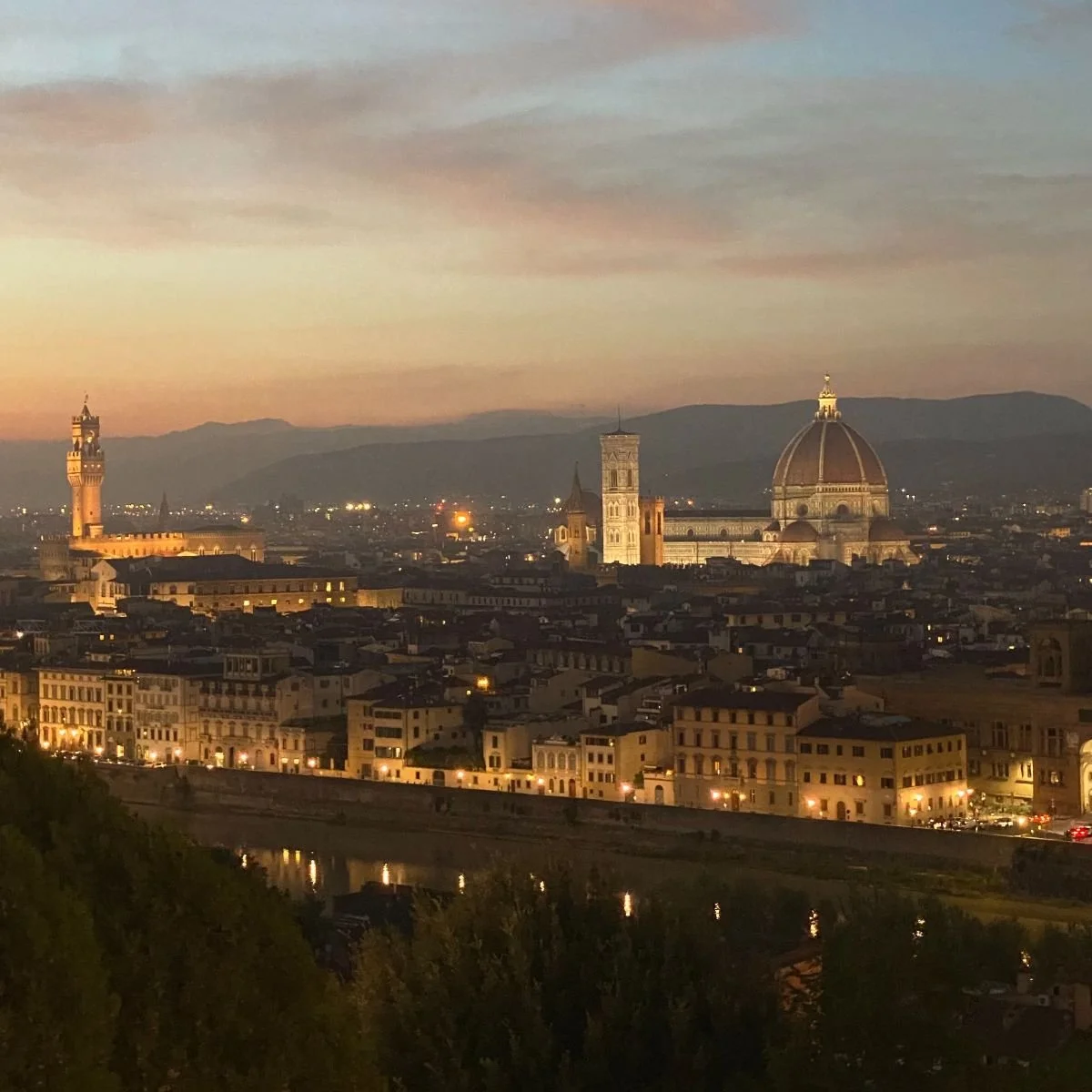
Starting over is rarely something we plan for. Sometimes it arrives through loss, disruption, or the simple fact that what once worked no longer does. After more than 25 years teaching yoga, meditation, and Yoga Nidra, I’ve seen the same pattern in practice and in life: endings often create the conditions for a different kind of beginning. Walking through Florence right now, surrounded by the evidence of collapse, rebuilding, and Renaissance, I’m reminded that starting over does not always mean recreating what was. Sometimes it means allowing what comes next to become something better.
The Temple of Jupiter & The Temple of Rock
This week, I’m walking the streets of Florence. Several people in my Tuscany Yoga retreat have also opted for my Florence Walking Tour and together, we’ll spend three days walking the cobblestone streets, climbing the cathedral’s impossible dome, and bearing witness to the genius of the Renaissance.
Our first stop is Piazza della Repubblica, ground zero for the city that was founded in 59 BC. We’ll see how an ancient Roman forum has been reborn over the centuries and millennia, how medieval marketplaces have morphed into swanky hotels and cafes and how the temple of Jupiter has been transformed into a Hard Rock Cafe, the temple of rock. I want to give my guests a footing on Florence's 2,000 years of beginning again.
Goths Bring Dark Times
Florence was originally called Florentia, meaning to flourish. And it did just that while Rome itself was thriving. But when such a powerful empire as Rome fell in 476, it left an enormous vacuum and Florence became vulnerable to loot, pillage, and burn. The Goths invaded and took over. I like to think of the Goths marching in with pallid and sad faces, wearing black lipstick and eyeliner, Robert Smith’s plaintive moans as their battle music. Even if this is wrong historically, it feels true to the emotional tone of the times. Hey, there’s a reason it was called the Dark Ages. People were too busy surviving to think about art, civics, or even humanity. Point is, everything was lost and people abandoned Florence and headed for the hills to escape the vulnerable city.
It took centuries for things to stabilize so people could return to Florence. And when they did, they were starting over—a new beginning, a new birth. As they started to rebuild, they looked backward to ancient times in order to move forward. Because everything was lost, nobody could paint by numbers. They had to figure it out on their own.
And they did. But they didn’t simply recreate the past. They made something better.
Staring Over

I attended college back in the era of floppy disks.
One evening, after weeks of wrestling with an essay, I sat down to print it. This was my magnum opus, both my senior thesis and my entry into a prestigious essay contest, and it was due the next day. I clicked the disk into the computer, went to find the file, and saw … nothing. Nada. Rien.
Floppy.
Everything on that disk had been mysteriously obliterated.
There was only one thing I could do: start over. It took all night.
The ideas were fresh; I’d practically memorized the thing. But this time, instead of wrestling with the words, I felt them tumble out of my brain and dance through my fingers onto the keyboard, fast and fluid. This time, the argument formed more clearly, with ideas I hadn’t considered the first time. This time, it had soul.
As dawn broke, I scanned my finished essay with bloodshot eyes. But it wasn’t the same essay. It was better. Much better.
I submitted it.
I graduated.
I took first place in the essay contest.
Part of the Cycle
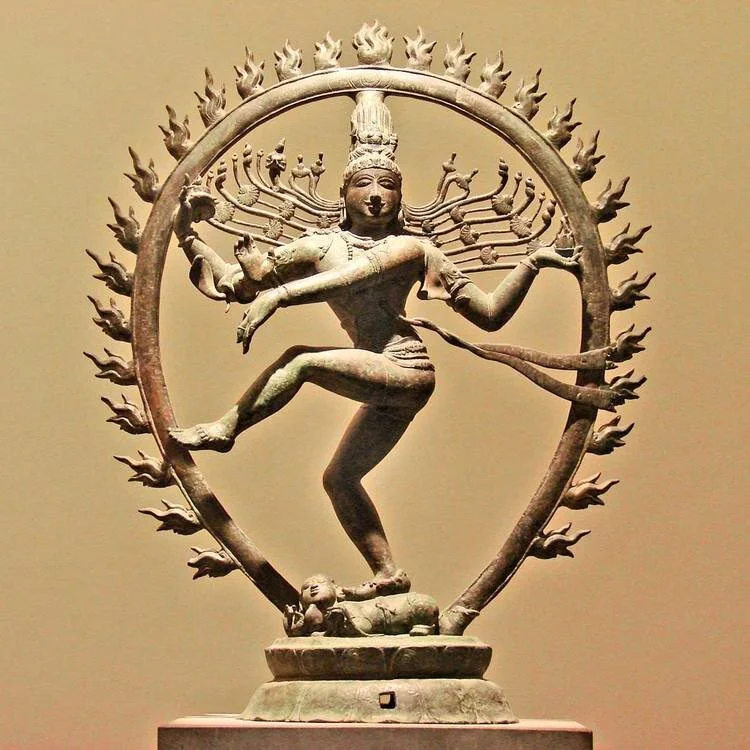
Starting over can be a blessing, even a catalyst for greatness. That doesn’t make it easy, and it doesn’t make loss or difficulty good. It means starting over is part of the design. The ancient yogis pictured it as Shiva Nataraj, dancing the whole cycle at once: birth, sustaining, dissolution, rebirth. The Renaissance shows that cycle on the scale of civilization. Our lives move through it on the scale of a single person. And when we are asked to rebuild, what comes through often isn’t a reconstruction. It’s a renaissance.
We are all somewhere in this cycle. Maybe you are building something, or sustaining something you love. Maybe something is falling away, or you’re in that strange space between what’s fallen away and what comes next. Wherever you are, you don’t need to do anything with it. Just notice.
Carry A Question
Whether you’re in Florence or at home, let a question rise up in you this week. Don’t rush to answer it. Just sit with it, and let the ordinary stuff of your week—your commute, the dishes, the grocery line—shed a little light on it.
If something comes into focus, hit reply and tell me about it. Or keep it to yourself and let daily life carry the conversation. Either way, I’m glad you’re here.
FAQ — Starting Over, Renaissance, and Rebirth
What does the Renaissance have to do with starting over?
The Renaissance offers a powerful example of what can happen when people rebuild after enormous change and loss. Rather than simply recreating the past, Florence looked backward for inspiration and created something new. Starting over can work the same way in our individual lives.
Why is Florence associated with rebirth?
Florence became one of the defining centers of the Renaissance, a period shaped by renewed interest in ideas, art, humanity, and culture. Its history offers a vivid example of how rebuilding can become something more than restoration.
What does Shiva Nataraj represent?
Shiva Nataraj represents a continuous cycle of birth, sustaining, dissolution, and rebirth. It offers a yogic way of understanding change: endings and beginnings are not separate events but parts of the same larger cycle.
Can starting over lead to something better?
Sometimes. Starting over doesn’t make loss or difficulty good, but rebuilding can create room for new ideas and possibilities. What emerges does not always have to be a reconstruction of what existed before.
How can I reflect on starting over in my own life?
Begin by noticing where you are in the cycle. You may be building something, sustaining something, watching something fall away, or sitting in the space before what comes next. You don’t necessarily need to fix or change anything. Start by noticing.